
The Bicep-Quad Rep Range Trap Costing You Gains
Biceps and quads respond to training differently due to their unique fiber type composition. Biceps contain more slow-twitch fibers that thrive with high reps and time under tension, while quads have more fast-twitch fibers that grow best with heavy loads and lower reps.
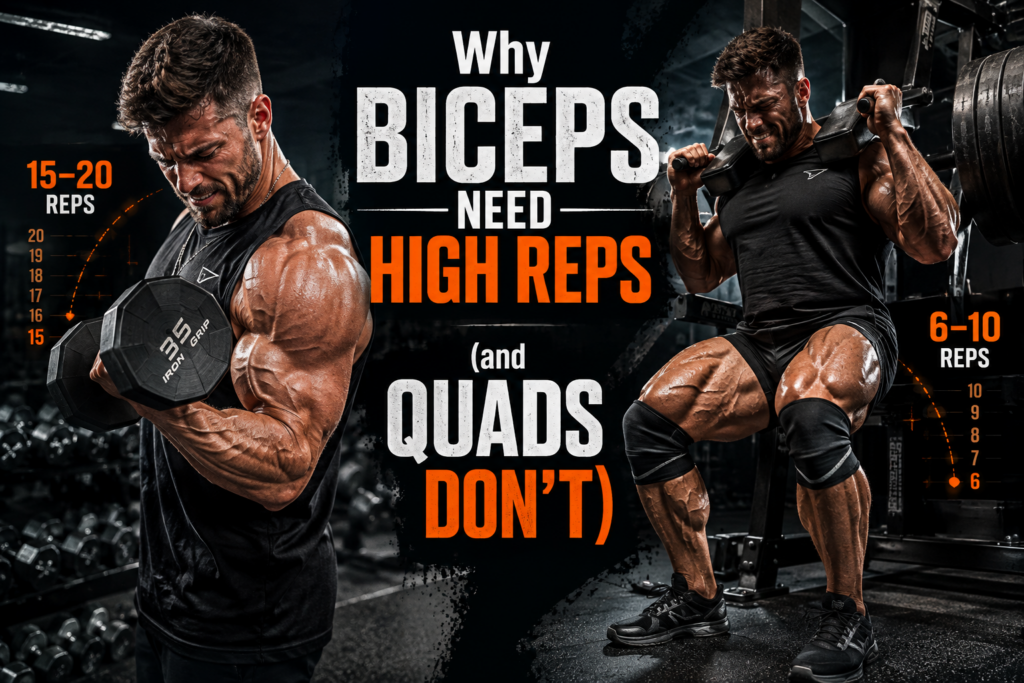
Why Biceps Need High Reps and Quads Don’t comes down to fundamental differences in muscle fiber types and structure between these two muscle groups. The fiber makeup of each muscle determines the rep range that works best, causing your biceps and quads to respond to training in opposite ways.
Why Biceps Need High Reps and Quads Don’t: The Fiber Type Split
Your quad muscles contain more fast-twitch fibers than your biceps. Fast-twitch fibers grow best from heavy loads and lower reps. They’re built for explosive power and strength. Quads use these fibers when you squat or jump.
Biceps have a higher proportion of slow-twitch fibers. Slow-twitch fibers respond better to higher rep ranges. They need more time under tension to grow. This is why your arms often feel pumped after many reps.
Research shows quads are roughly 50-60% fast-twitch in most people. Biceps sit closer to 60% slow-twitch. That’s a major difference in composition. It changes how you should train each muscle.
Heavy squats in the 3-6 rep range build quad mass effectively. The same approach on biceps leaves growth on the table. You need 12-20 reps per set for optimal bicep development.
Blood Flow and Pump: Why Biceps Need High Reps and Quads Don’t Respond the Same
Biceps are smaller muscles with less total blood volume. They need sustained tension to maximize blood flow. High reps create metabolic stress that triggers growth. This pump effect matters more for arms than legs.
Quads are massive muscles with extensive vascular networks. They get enough blood flow from just a few heavy reps. The mechanical tension from heavy weight drives their growth. Metabolic stress plays a smaller role.
When you do 15 curls, blood pools in your biceps. The muscle swells and growth signals activate. This is called cellular swelling. It’s a proven pathway to muscle growth.
Quads don’t need this same swelling effect. Three heavy squats create more growth stimulus than 20 light ones. The load itself causes enough muscle damage and tension.
Your biceps also fatigue differently than your quads. Arms tire quickly under sustained tension. Legs can handle brief, intense loads better. This matches their fiber composition perfectly.
Recovery Patterns Explain Why Biceps Need High Reps and Quads Don’t
Small muscles like biceps recover faster than large muscle groups. You can train them more frequently with higher volume. This makes high rep work practical and effective. Your biceps can handle the stress.
Quads take 48-72 hours to recover from heavy training. They’re involved in daily movement and bear your body weight. Adding high rep work just creates excess fatigue. Recovery becomes the limiting factor.
High rep bicep work causes less systemic fatigue overall. Your whole body doesn’t feel drained afterward. You can do arm work multiple times per week. Supporting recovery with proper supplementation helps maintain this training frequency.
Heavy quad training taxes your entire nervous system. Low bar squats for sets of 5 require full-body coordination. Your spine, core, and grip all work hard. This creates fatigue beyond just the quads.
Bicep curls are isolated movements with minimal systemic demand. You can push close to failure without risking injury. The same isn’t true for heavy squats or leg presses.
Range of Motion and Why Biceps Need High Reps and Quads Don’t Use It the Same
The bicep has a shorter range of motion than the quad. A full curl moves your hand maybe 18 inches. A full squat moves you through several feet. This affects how you accumulate volume.
More reps on biceps means more total distance traveled. This adds up to significant time under tension. Each rep is quick but many reps create the needed stimulus.
Quads get enough range covered in just a few reps. One deep squat takes your knee through 120 degrees of flexion. That’s massive mechanical work in a single repetition. You don’t need 15 of them.
The stretch position also matters differently for each muscle. Biceps grow well from constant tension throughout the range. Quads respond more to the stretch at the bottom. Heavy loads in deep positions trigger quad growth.
You can’t load biceps as heavily relative to their size. A 40-pound dumbbell is heavy for curls. That same weight is nothing for leg exercises. This forces you toward higher reps on arms.
Joint Stress and Why Biceps Need High Reps and Quads Don’t Share the Same Risks
Your knee and hip joints can handle heavy loads safely. They evolved to support and move your body weight. Squatting 200 pounds stresses the joints but within their design capacity.
Elbow joints are smaller and more delicate. They weren’t built for maximum loads. Heavy low-rep curls can cause tendon inflammation quickly. High reps with moderate weight keep joints healthier.
Heavy squats actually strengthen connective tissue around your knees. The load signals your body to reinforce those structures. This is a positive adaptation when done correctly.
Heavy bicep curls with poor form create chronic elbow issues. The risk-to-reward ratio favors lighter weights and more reps. Your tendons will thank you years later.
Lower body exercises allow for better leverage and stability. You can brace your whole body during a squat. Bicep curls offer no such advantage. The arm works in relative isolation.
Practical Training: Why Biceps Need High Reps and Quads Don’t Get the Same Sets
A good quad workout might include 4 sets of 5 squats. That’s 20 total reps of heavy work. Your quads will grow from this stimulus. Adding more reps adds fatigue without extra growth.
Effective bicep training needs 3-4 sets of 12-15 reps per exercise. That’s 36-60 total reps to match the quad stimulus. The volume looks different but the growth effect is similar.
You might do squats, leg press, and lunges all for 5-8 reps. Each exercise stays in the strength-focused range. This builds quad mass efficiently.
Bicep routines should mix rep ranges but favor higher numbers. Maybe 10-12 on barbell curls and 15-20 on cable work. This targets the slow-twitch fibers properly. Quality muscle support supplements can enhance your results from this higher volume approach.
Rest periods differ too. You might rest 3 minutes between heavy squat sets. Bicep work only needs 60-90 seconds between sets. The recovery demands match the muscle size.
Why Biceps Need High Reps and Quads Don’t: The Hormonal Response
Heavy compound lifts like squats trigger larger hormone releases. Testosterone and growth hormone spike after hard leg training. This is a whole-body anabolic signal. It helps all muscles grow.
Bicep curls create a more localized growth response. The hormonal effect is smaller and more targeted. You need metabolic stress to compensate. High reps create that stress.
Your body treats heavy squats as a survival challenge. It responds by getting stronger everywhere. This systemic effect makes low-rep quad work efficient.
Arm training doesn’t trigger the same system-wide response. You need to create growth signals locally in the muscle. Time under tension and muscle damage do this. Both come from higher rep work.
The pump you feel in biceps isn’t just cosmetic. It signals cellular processes that lead to growth. Quads don’t need this same pump sensation. Mechanical overload is enough.
Individual Variation in Why Biceps Need High Reps and Quads Don’t
Some people have more fast-twitch fibers in their arms. They might respond to lower reps on biceps. But they’re the exception. Most people fit the pattern described here.
You can test your own fiber composition through training. If your biceps grow from 5-8 rep sets, keep doing that. Most will find 12-20 works better.
Quad fiber ratios vary less between individuals. Nearly everyone responds well to heavy, low-rep leg work. Genetics rarely change this principle.
Your training age also matters. Beginners grow from almost anything. The fiber-specific approach becomes important after a year of consistent training. That’s when optimization matters.
Athletes in different sports may develop different fiber ratios. Sprinters have more fast-twitch quads than distance runners. But even sprinters have slower-twitch biceps. Proper nutrition and supplementation supports muscle development regardless of your starting point.
Frequently Asked Questions
Can I build biceps with low reps?
You can build some bicep size with low reps. But most people get better results from 12-20 reps per set. The fiber composition of biceps responds better to higher volume. Heavy low-rep work creates more elbow stress than muscle growth.
Should I ever do high reps for quads?
High rep quad work can be useful occasionally. It builds muscular endurance and creates variety. But it shouldn’t be your main approach. Heavy sets of 5-8 reps build more quad mass. Save high reps for the end of your leg workout.
How many sets do biceps need per week?
Most people need 12-18 sets per week for biceps. Spread this across 2-3 training sessions. Each set should reach near failure in the 12-20 rep range. More sets than this often lead to overtraining for arms.
What rep range builds the strongest quads?
Sets of 3-6 reps build maximum quad strength. This range allows the heaviest loads. It targets the fast-twitch fibers that create power. You need full recovery between these heavy sets. They work best early in your workout.
Do calves train like biceps or quads?
Calves are more like quads in fiber composition. But they respond to a mix of rep ranges. Many people find calves need very high reps, 15-25 per set. Calves are stubborn and need lots of volume. They’re different from both biceps and quads.
Start your next arm workout with sets of 15 curls instead of 8 and watch your biceps respond.