
Why Your Bro Split Is Costing You Gains
The traditional bro split trains each muscle only once weekly, wasting five days of potential growth after protein synthesis peaks. Higher frequency training splits like PPL and upper/lower maximize muscle-building signals and deliver faster gains when volume is properly matched.
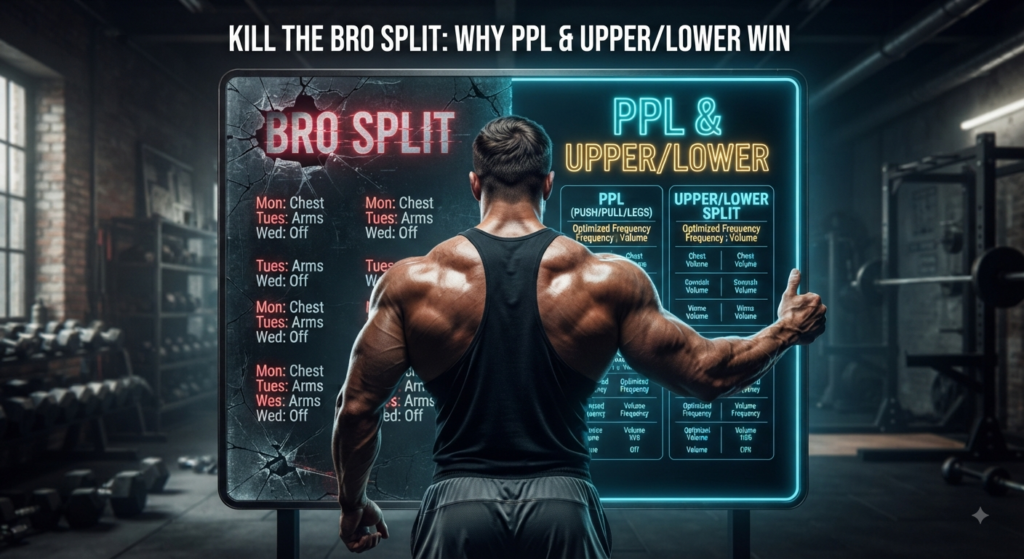
Kill the Bro Split: Why PPL & Upper/Lower Win is the shift serious lifters are making. Training each muscle once per week leaves gains on the table. Higher frequency builds muscle faster when volume matches up. Smart splits let you recover better and grow stronger.
Kill the Bro Split: The Frequency Problem You Can’t Ignore
The bro split trains chest Monday, back Tuesday, shoulders Wednesday, and so on. Each muscle gets hit once every seven days. That’s a week between training sessions for the same muscle group. Protein synthesis stays high for roughly 48 hours after training. After that window closes, growth signals drop back to baseline.
You’re leaving five days on the table where nothing happens. The muscle just sits there waiting for the next session. Meanwhile, lifters using push pull legs or upper lower train each muscle twice weekly. They get two growth windows instead of one.
The math is simple. Two sessions per muscle per week means double the stimulus. You don’t need to double the volume in each session either. Split your weekly sets across two days instead of cramming everything into one.
Recovery actually improves with this approach. Ten sets for chest on Monday wrecks you for days. Five sets on Monday and five on Thursday lets you train hard both times. You hit the same total volume without the crushing soreness.
Why PPL and Upper Lower Beat Single Muscle Days
Push pull legs groups muscles by movement pattern, not body part. Push day covers chest, shoulders, and triceps. Pull day trains back and biceps. Leg day handles quads, hamstrings, glutes, and calves. Run the cycle twice weekly and every muscle gets trained every 3.5 days.
Upper lower splits this differently. Upper body days train all pushing and pulling muscles together. Lower body days cover everything from the waist down. Four sessions per week means each half gets hit twice.
Both systems allow you to manage fatigue better than bro splits. When you train chest, your triceps are already warmed up from pressing. Adding tricep isolation takes minimal extra effort. The synergy between muscle groups makes sessions more time efficient.
You can also adjust training frequency based on your schedule. Running PPL six days weekly works for people with time. Three days weekly still beats training each muscle once. Upper lower fits perfectly into four days but scales down to three if needed.
The real advantage shows up in your training logs. Strength gains happen faster when you practice movement patterns more often. Benching twice weekly improves your bench press more than once weekly. Your nervous system adapts to the lift through repetition.
Kill the Bro Split With Proper Volume Distribution
Most lifters doing bro splits pack too many sets into one session. Chest day might include four exercises with four sets each. That’s 16 sets when you’re fresh at the start and burned out by the end. The last eight sets happen in a fatigued state.
Quality drops as the session drags on. Your final sets use lighter weight with worse form. The stimulus per set decreases even though you’re working hard. You’d build more muscle doing eight quality sets than 16 mediocre ones.
Push pull legs lets you spread volume across multiple sessions. Eight sets for chest on push day one, eight more on push day two. Each set gets performed when you’re relatively fresh. The total stimulus increases even though weekly volume stays the same.
Research shows that muscles respond better to moderate volume distributed frequently. Hitting 12 to 20 sets per muscle per week across two or three sessions beats doing it all at once. The sweet spot sits around 8 to 10 sets per muscle per session.
This approach also prevents the junk volume problem. Junk volume is sets that create fatigue without contributing to growth. When you’re deep into a long session, additional sets just dig a recovery hole. Shorter, more frequent sessions keep every set productive.
How Kill the Bro Split Supports Real Recovery
Bro splits create uneven recovery demands throughout the week. Leg day destroys you completely. The next day you’re hobbling around barely able to train anything else. Two days later you feel normal again but there’s still four days until legs come back around.
Upper lower and PPL balance the workload across the week. No single session leaves you completely wrecked. You accumulate fatigue gradually instead of spiking it on one day. This makes it easier to show up and perform well in every session.
Systemic fatigue matters as much as local muscle fatigue. When one massive session drains your whole body, subsequent workouts suffer. A brutal leg day Monday can ruin your back workout Tuesday. Even though different muscles are involved, your overall capacity is diminished.
Splitting volume prevents this spillover effect. Each session taxes your system moderately. You can recover between workouts without needing full rest days constantly. The result is more total training volume across the week.
Sleep quality improves too. One extremely hard session can disrupt sleep that night. Moderate sessions let you recover without the cortisol spike. Better sleep means better recovery and more muscle growth overall.
Kill the Bro Split and Match Your Training to Your Goals
Bodybuilders in the 1970s made the bro split famous. They also used massive amounts of performance enhancing drugs. Recovery ability on drugs far exceeds natural lifters. What worked for them doesn’t translate to you. Enhanced recovery from anabolic steroids, testosterone, growth hormone, and insulin dramatically increases muscle protein synthesis rates and reduces recovery time between sessions. Natural lifters operating with baseline testosterone levels require different training approaches to optimize hypertrophy without pharmacological support.
Natural lifters need higher frequency to maximize growth. You can’t rely on pharmacological recovery. Your body needs repeated stimuli to build muscle efficiently. Once weekly isn’t enough when protein synthesis drops after 48 hours.
Strength athletes never use bro splits. Powerlifters squat multiple times weekly. Olympic lifters practice their lifts almost daily. They understand that skill and strength require frequent practice. Hypertrophy responds to the same principle.
Even if mass is your only goal, treating lifting as a skill helps. Better technique means more tension on target muscles. More frequent practice leads to better technique. The muscle building follows naturally from improved movement quality.
If you’re serious about results, supporting your training with proper nutrition and recovery tools makes the difference. Food and supplements become more important when training frequency increases. Your body needs raw materials to rebuild muscle tissue twice as often.
The Practical Setup for Kill the Bro Split Success
Switching to PPL or upper lower requires some planning. You need to redistribute your exercises across new sessions. Take your current weekly volume for each muscle and divide it across two or three workouts.
For push pull legs, each push day should include pressing for chest and shoulders. Add some tricep work at the end. Pull days cover rowing and pulling for back plus bicep curls. Legs get squats, deadlift variations, and direct hamstring or quad work.
Upper lower works similarly but combines push and pull in one session. Upper days might start with a heavy press, add some rowing, then finish with arm work. Lower days begin with squats or deadlifts, then add accessory movements for quads and hamstrings.
Start with three to four exercises per muscle group weekly. Distribute them across your sessions. If you were doing four chest exercises Monday, do two on push day one and two on push day two. Keep the same total sets.
Track your performance on key lifts. When you train movements twice weekly, strength should climb faster. If it doesn’t, you’re either not recovering or not eating enough. Adjust calories and sleep before blaming the program.
Give the new split at least six weeks before judging results. Your body needs time to adapt to higher frequency. The first two weeks might feel harder as you adjust. After that, recovery catches up and gains accelerate.
Why Kill the Bro Split Makes Every Session Count
The bro split encourages a mentality of annihilating one muscle per session. You go in planning to destroy chest. The goal becomes creating as much damage as possible. Soreness becomes the measure of a good workout.
This thinking is backwards. Muscle damage contributes to growth but isn’t the primary driver. Mechanical tension and metabolic stress matter more. You can create both without crippling soreness. In fact, excessive damage just interferes with your next session.
Higher frequency training shifts your focus to performance. Each session becomes about executing quality sets. You’re not trying to annihilate anything. You’re building the muscle through consistent, progressive work.
This mindset leads to better long term results. Chasing destruction leads to burnout and injury. Chasing performance leads to steady progress. You add weight to the bar, improve your technique, and push your rep counts higher.
Consistency becomes easier when sessions feel manageable. Missing a workout on a bro split means missing that muscle for another week. Missing one session on PPL means you still hit everything twice if you make up the other sessions. The system has built in flexibility.
How Kill the Bro Split Works for Advanced Lifters
Beginners benefit most from frequent training because they’re learning movements. Advanced lifters might wonder if they need more volume per session. The answer is no. Frequency still wins even with years of experience.
Advanced lifters can handle more total volume per week. But cramming it into fewer sessions creates the same problems as before. You end up doing junk volume when fatigue is high. Spreading sets across more days keeps quality high.
You can also specialize on weak points more easily with higher frequency. If your shoulders lag, adding an extra push day lets you emphasize delts. You can’t do that effectively on a bro split without creating a massive imbalanced session.
Progressive overload becomes more precise with frequent training. Adding five pounds to your bench twice weekly gives you more data points. You can see if strength is actually climbing or just fluctuating. Adjustments happen faster when feedback comes more often.
Many advanced lifters also find that strategic supplementation helps maintain performance across multiple weekly sessions. Joint support and recovery aids become more valuable when training density increases. Your body needs help managing the increased workload.
When Kill the Bro Split Fits Your Schedule Best
Some people worry that training more days weekly requires more time. This isn’t true if you manage session length properly. A bro split might have you in the gym 90 minutes Monday. PPL lets you finish in 60 minutes because you’re doing less per session.
Six day PPL splits work well for people who prefer shorter daily sessions. Each workout takes under an hour. You hit every muscle twice weekly without any single marathon session. The total weekly time is the same as four longer workouts.
Four day upper lower suits people who want rest days between sessions. You can train Monday, Tuesday, Thursday, Friday. This leaves three full days for recovery. It’s also easier to schedule around work and life commitments.
Three day full body splits are another option for Kill the Bro Split goals. Train Monday, Wednesday, Friday with all major muscle groups each day. This gives you twice weekly frequency with minimal time commitment. Each session runs 60 to 75 minutes.
The key is matching your split to your actual schedule, not an ideal fantasy schedule. If you can realistically train four days weekly, upper lower wins. Don’t design a six day program you’ll never stick to. Consistency beats perfection.
What Kill the Bro Split Means for Your Nutrition
Training muscles more frequently changes your nutrition needs. Your body is constantly repairing tissue instead of doing it once weekly. Protein needs increase slightly because synthesis happens more often throughout the week.
Aim for protein intake around 0.8 to 1 gram per pound of body weight. Spread it across four to five meals daily. This ensures amino acids are available whenever your body needs them. Missing meals matters more when you’re training frequently.
Carbohydrate timing also becomes more important. You’re training more days weekly so you need fuel more often. Eating carbs around your workouts helps performance and recovery. Don’t try to low carb diet while running high frequency splits.
Micronutrients get depleted faster with increased training volume. Magnesium, zinc, and vitamin D all support recovery. Whole foods should cover most needs but gaps can develop. Tracking your diet for a week reveals if you’re missing anything.
Many lifters find that adding quality supplements fills nutritional gaps that appear with higher training demands. This becomes especially important during fat loss phases when food intake drops. You need every advantage to maintain muscle while cutting calories.
Frequently Asked Questions
Can beginners use push pull legs or upper lower splits?
Yes, beginners benefit even more from higher frequency training than advanced lifters. Learning movements requires practice and repetition. Training each pattern twice weekly accelerates skill development. Start with moderate volume and add sets as you adapt.
How much volume should each muscle get per week?
Most people grow best with 12 to 20 sets per muscle per week. Beginners start at the lower end. Advanced lifters can push toward the higher end. Distribute this across two to three sessions for best results.
What if I can only train three days weekly?
Three day full body splits work perfectly for this schedule. Train all major muscle groups each session. Each muscle still gets hit multiple times per week. You won’t match six day PPL volume but results still beat bro splits.
Will I lose strength switching from a bro split?
No, strength typically increases when switching to higher frequency training. You practice lifts more often which improves skill. The nervous system adapts faster with more frequent exposure. Give it four weeks to fully adapt to the new stimulus.
How long should rest periods be on these splits?
Rest two to three minutes between heavy compound sets. Rest 60 to 90 seconds between isolation exercises. Shorter sessions don’t mean rushing through rest periods. Quality sets require adequate recovery between them.
Pick either push pull legs or upper lower based on your schedule and commit to it for eight weeks minimum.