
Why Your Favorite Squat Bar Might Be Killing Quad Growth
Bar placement is the key difference between high bar, low bar, and SSB squats, with each position changing your torso angle to target your quads differently. Understanding these variations helps you select the squat style that builds the most leg mass for your goals.
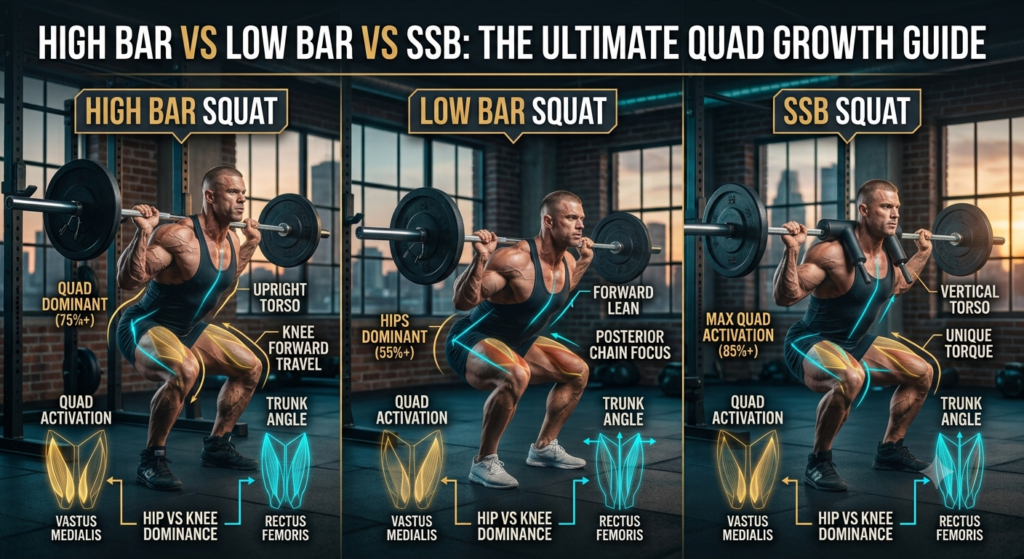
Walk into any serious gym and you’ll see three squat variations. Each one targets your quads differently. High Bar vs Low Bar vs SSB: The Ultimate Quad Growth Guide shows which builds the most leg mass.
How Bar Position Changes Everything in High Bar vs Low Bar vs SSB
Bar placement controls your torso angle during every squat rep. High bar sits on your traps and keeps you upright. Low bar rests three inches lower on your rear delts. This small shift tilts your torso forward by fifteen degrees.
The Safety Squat Bar curves around your neck with padded handles. Your hands grip the handles in front instead of reaching back. This design forces an even more upright position than high bar.
Your torso angle determines how much your quads work. A vertical back puts maximum tension on your quadriceps muscles. Forward lean transfers work to your glutes and lower back instead.
Powerlifters choose low bar because the forward lean lets them lift heavier. Bodybuilders prefer high bar because upright positions isolate the quads better. SSB sits between these two for quad focus.
Quad Activation Data: High Bar vs Low Bar vs SSB
EMG studies measure electrical activity in muscle fibers during exercise. High bar squats show thirty percent more quad activation than low bar. The upright torso keeps constant tension on your thighs throughout the movement.
Low bar squats recruit your posterior chain harder instead. Your hamstrings and glutes fire more to control the forward lean. This makes low bar better for total strength but worse for pure quad growth.
Safety Squat Bar forces the most upright torso of all three. The cambered bar shifts the weight forward naturally. Your body compensates by staying more vertical to maintain balance.
Studies comparing all three variations show SSB produces similar quad activation to high bar. Some lifters report even better quad engagement with SSB. The padded design also removes shoulder stress completely.
Your knee travel forward matters as much as torso angle. High bar and SSB both allow knees to move past toes freely without compensation patterns. This forward knee position increases quadriceps stretch and time under tension at the bottom position. Greater anterior knee translation also enhances the eccentric loading phase, which is critical for hypertrophy. Low bar restricts forward knee movement due to the posterior chain demands and torso angle, limiting the range of motion through which your quads work. The difference in knee positioning between variations directly impacts quad fiber recruitment and mechanical tension.
Depth and Knee Flexion in High Bar vs Low Bar vs SSB Squats
Getting below parallel depth multiplies quad activation by forty percent. High bar makes deep squats easier because your upright torso fits between your legs. You can drop into a full squat without balance issues.
Low bar squats often stop at parallel instead. The forward lean creates balance problems in deep positions. Your torso would need to fold too far forward to reach full depth.
Knee flexion increases as you descend deeper into any squat. Maximum flexion happens at rock bottom depth. This fully stretches your quad muscles before the concentric phase.
SSB allows the deepest squats of any variation for most people. The bar position naturally keeps your center of gravity back. You can sit into a deep position without tipping forward.
Deep squats with SSB also feel safer on your lower back. The upright torso reduces spinal compression at the bottom. This lets you push quad volume higher without back fatigue.
Programming Volume: High Bar vs Low Bar vs SSB for Maximum Quad Size
Muscle growth needs ten to twenty working sets per week per muscle group. High bar lets you accumulate this volume because it taxes your lower back less. You can train squats twice weekly without excessive fatigue.
Low bar squats create more systemic fatigue from the heavy posterior chain work. Most lifters can only handle one heavy low bar session weekly. This limits total quad volume significantly.
SSB offers the best volume potential of all three variations. The reduced lower back stress lets you push sets harder. Many bodybuilders do twenty sets of SSB squats weekly without overtraining.
Your recovery capacity determines how much volume you can handle. High bar and SSB both allow faster recovery than low bar. You can train legs again after just two days.
Front-loading quad volume early in your session works best. Do high bar or SSB first when energy is highest. Save low bar for strength phases instead of hypertrophy blocks.
Unlock Peak Thigh Performance: How to Build Mass, Double Your Energy
Injury History and Individual Anatomy for High Bar vs Low Bar vs SSB
Shoulder mobility limits low bar squats for many lifters. You need to rotate your arms back significantly to grip the bar. Poor shoulder flexibility makes this position painful or impossible.
High bar needs less shoulder mobility but still requires some external rotation. Wrist flexibility also matters because your hands support the bar behind you. Previous shoulder injuries often rule out both variations.
SSB eliminates all shoulder and wrist requirements completely. The handles sit in front where you can grip them easily. This makes SSB the only option for lifters with upper body injuries.
Hip structure also affects which squat variation works best for you. Shallow hip sockets allow deep high bar and SSB squats easily. Deep sockets create impingement at the bottom of upright squats.
People with hip impingement often squat better with low bar. The forward lean opens up the hip joint mechanically. This lets you reach depth without bone-on-bone contact.
Knee pain typically improves with SSB compared to other variations. The upright position distributes force more evenly across the joint. High bar can aggravate patellar tendinitis in some lifters.
Combining All Three Variations in Your Quad Training Split
Using multiple squat variations in one program builds more complete quad development. Each variation stresses your muscles at different angles and lengths. This creates more growth stimulus than repeating one movement.
Start your leg day with the variation you want to prioritize. If quad growth is the goal, begin with high bar or SSB. Push these movements closest to failure for maximum hypertrophy.
Add a second squat variation later in the same workout at lighter weight. Do high bar heavy, then finish with SSB for high reps. This extends time under tension without excessive loading.
Some lifters alternate variations between leg workouts instead. Monday uses SSB for four sets of eight reps. Thursday switches to high bar for three sets of twelve.
Low bar fits best during dedicated strength blocks. Use it for three to five rep sets to build your one-rep max. Switch back to high bar or SSB for hypertrophy phases.
Never do heavy low bar and heavy high bar in the same week. The overlapping fatigue prevents recovery and kills quad growth. Pick one main squat variation per training cycle.
Practical Setup Differences Between High Bar vs Low Bar vs SSB
High bar placement sits directly on top of your traps. Squeeze your shoulder blades together to create a shelf. The bar should feel stable without your hands supporting much weight.
Low bar rests across your rear delts and spine of scapula. This creates a lower shelf about three inches down. Your grip needs to be wider to reach this position.
SSB setup is the simplest of all three variations. Place the padded section on your traps and grab both handles. Your elbows stay down rather than pulled back.
Stance width changes slightly between variations for most people. High bar typically uses a shoulder-width stance with toes slightly out. Low bar often needs a wider stance to accommodate the forward lean.
SSB works well with a narrower stance than other squat types. The upright torso position allows your knees to track forward freely. This targets your quads even harder than standard high bar.
Loading Differences and Strength Carryover
You’ll lift the most weight with low bar squats always. The mechanical advantage from forward lean adds fifty to seventy-five pounds. This variation lets you move maximum absolute load.
High bar loads fall about fifteen percent below low bar numbers. The upright position creates a longer moment arm for the weight. Your quads work harder per pound lifted though.
SSB loads typically match or slightly exceed high bar weights. The bar design actually helps some lifters move more weight. Others find it ten pounds lighter than their high bar max.
Strength from low bar transfers well to high bar squats. The opposite transfer is less complete because low bar needs different technique. Building high bar strength adds maybe twenty pounds to low bar.
SSB strength carries over to both other variations surprisingly well. The quad development translates directly to high bar performance. The upper back work from holding SSB even helps low bar stability.
Frequently Asked Questions
Which squat variation builds the biggest quads?
High bar and SSB both build more quad mass than low bar. The upright torso angle keeps maximum tension on your quadriceps. SSB may have a slight edge for lifters with shoulder issues.
Can beginners start with Safety Squat Bar?
Yes, SSB is excellent for beginners learning squat patterns. The handles make balance easier to control than other variations. The upright position also teaches proper depth naturally.
Should powerlifters avoid high bar squats completely?
No, high bar builds quad strength that helps low bar performance. Many powerlifters use high bar during off-season training blocks. The added quad mass improves their competition low bar squat.
How often should you switch between squat variations?
Change your main squat variation every four to eight weeks. This prevents adaptation while building complete leg development. Keep one variation as your primary focus each training block.
Does SSB work for strength training or just hypertrophy?
SSB works excellently for both strength and hypertrophy training. Many strongman competitors use SSB as their primary squat variation. The reduced spinal loading allows heavy weights with lower injury risk.
Pick your main squat variation based on your goal and test it for six weeks.