

Why Your CNS Ceiling Blocks 40% of Possible Gains
Your muscles may be strong enough to lift heavier weights, but CNS fatigue prevents your brain from fully activating them, creating a hidden ceiling on your progress. Neural drive, not muscle mass alone, determines how much weight you can lift and how quickly your body recruits muscle fibers.
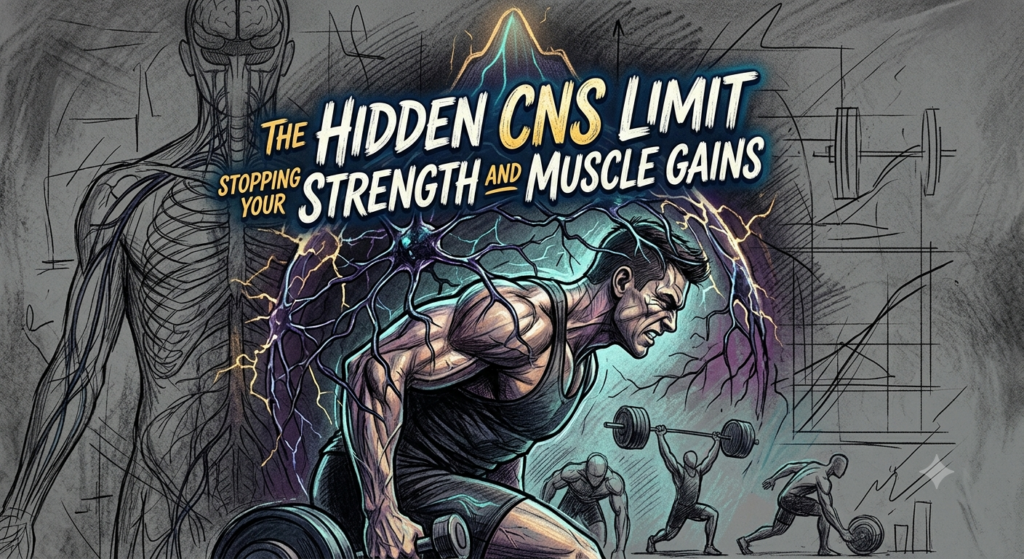
The Hidden CNS Limit Stopping Your Strength and Muscle Gains happens when your nervous system runs out before your muscles do. You set a new personal best on Monday. By Friday, the same weight feels impossible. Your brain can’t recruit the muscle you’ve built.
Why The Hidden CNS Limit Stopping Your Strength and Muscle Gains Matters More Than Your Program
Your ability to activate a muscle during a maximal effort drops when the CNS fatigues. This means the muscle is there but your brain can’t turn it on. The motor unit pool hits a ceiling around 90% recruitment in trained lifters, then shifts to firing speed and coordination.
Two people with identical muscle mass lift different weights. The difference is neural drive. It controls how many motor units fire, how fast they fire, and how antagonist muscles release. You can own all the muscle in the world. Without the signal to switch it on, it’s decoration.
After four weeks of strength training, motor units recruit at lower thresholds and discharge rate increases by 3.3 pulses per second. This adaptation comes from your nervous system, not new muscle. You get stronger before you get bigger.
The Three Brain Mechanisms That Kill Your Lifts
CNS fatigue happens through three distinct mechanisms: decreased excitatory input to the motor neuron (reduced neural drive and motor unit recruitment), increased inhibitory input from Renshaw cells and antagonist muscle activation (protective braking), or reduced responsiveness of the motor neuron itself due to acetylcholine depletion and neurotransmitter fatigue. Your brain stops sending strong signals through lower frequency discharge rates. It starts blocking the signals it does send via increased central inhibition. Your motor neurons stop listening due to decreased sensitivity at the neuromuscular junction and sarcolemmal changes.
This isn’t abstract science. When 50% of your one-rep max feels heavy or the start is sluggish, your CNS hasn’t recovered. The bar speed tells you everything. Fast bar speed with light weight means your nervous system is ready. Slow bar with light weight means rest more.
Maximal lifts above 95% of your one-rep max require nearly a full week for the CNS to recover, which explains why high-intensity days programmed too close lead to burnout. This isn’t soft programming. It’s biology. Stack max effort days and your nervous system taps out.
How The Hidden CNS Limit Stopping Your Strength and Muscle Gains Shows Up In Real Training
CNS activation takes only 20 minutes to return to baseline after heavy biceps training, then surpasses it in the following hours. The nervous system bounces back fast from single sessions. The problem is accumulated sessions without breaks.
After high volume squat workouts, both trained and untrained subjects show CNS fatigue lasting at least 72 hours. Three days minimum. Not one day. Not two. You might feel fine the next day but your nervous system is still down.
CNS fatigue accumulates during a workout, so shorter rest periods reduce muscle activation and the overall growth stimulus. Rushing between sets doesn’t make you tougher. It makes you weaker during the set that actually matters.
The Sleep and Recovery Trap Most Lifters Miss
During sleep, the brain clears metabolic byproducts from neural activity and replenishes depleted neurotransmitter levels, restoring optimal neural signaling and improving focus and motor commands. Sleep isn’t downtime. It’s when your brain fixes itself.
Aim for seven to nine hours of quality sleep to help your body repair and prepare. Not six hours. Not scattered sleep interrupted four times. Solid, unbroken sleep where your brain actually completes its repair cycle.
Heart rate variability measures time between heartbeats and reflects nervous system balance, decreasing when the sympathetic nervous system activates under physical or mental stress. Track your HRV. Low numbers mean your nervous system is still fighting yesterday’s workout.
Unlock Peak Performance: How to Build Mass, Double Your Energy, and Maximize Vitality
The Signs The Hidden CNS Limit Stopping Your Strength and Muscle Gains Is Crushing You
Persistent fatigue, trouble sleeping, irritability, prolonged muscle soreness, and performance plateaus signal your body needs rest. One symptom could be anything. Three symptoms together is a message. Your nervous system is screaming.
When fatigue accumulates, athletes become more irritable or anxious, and in extreme cases show hard-to-control emotional reactions that strengthen the likelihood of overtraining. You snap at people. Small problems feel massive. This isn’t a personality issue. It’s a nervous system issue.
Slower bar speed on lifts shows CNS fatigue even when muscles have physically recovered. Film your lifts. Compare bar speed at the same percentage week to week. Slower speed with the same weight means back off.
Deload Weeks Fix The Hidden CNS Limit Stopping Your Strength and Muscle Gains
Heavy lifting taxes the CNS more than anything else, so reduce working weights to 50-60% of normal loads while keeping sets and reps the same. You maintain movement patterns. Your nervous system gets a break. Your technique might even improve.
Strength athletes should deload every four to six weeks, especially during peaking cycles when training intensity is highest. This isn’t optional for advanced lifters. It’s required. Many athletes see problems after 6 to 12 week blocks of heavy work.
A planned recovery week every four to six weeks dissipates fatigue while preserving fitness. You don’t lose strength in a week. You clear out accumulated damage. Then you come back and set new records.
Programming Around The Hidden CNS Limit Stopping Your Strength and Muscle Gains
Wave loading alternates between heavy, medium, and light sessions throughout the week, giving the CNS and muscles time to recover while providing progressive overload. Don’t grind near-maximal weights every session. Rotate intensity and let your brain recover between hard days.
Every workout doesn’t need to be an all-out grind, and alternating high-intensity sessions with moderate or low-intensity days gives your CNS a needed break. Hard Monday, medium Wednesday, light Friday. This pattern works because your nervous system gets two recovery windows per week.
Deloading is planned into programs to prevent CNS fatigue regardless of how the body feels, and this is common for powerlifters. Don’t wait until you feel destroyed. Schedule the deload before you need it. Prevention beats damage control.
Frequently Asked Questions
What is CNS fatigue in strength training?
CNS fatigue is when your nervous system can’t activate your muscles fully during hard efforts. Your muscle is present but your brain can’t recruit it. Bar speed slows down even with weights you normally handle easily.
How long does it take to recover from CNS fatigue?
Recovery from single heavy sessions takes 20 minutes to a few hours. Accumulated CNS fatigue from high volume workouts lasts at least 72 hours. Maximal lifts above 95% need nearly a full week for complete nervous system recovery.
Do low reps or high reps cause more CNS fatigue?
Low intensity, high duration exercise causes far more central fatigue than short, high intensity exercise. Heavy sets of three reps recover faster than marathon training. The nervous system handles intensity better than endless volume.
How often should I deload to prevent CNS fatigue?
Strength athletes should deload every four to six weeks. Hypertrophy programs allow five to eight weeks between deloads. During fat loss phases, deload every three to five weeks because recovery capacity drops.
Can sleep alone fix CNS fatigue?
Sleep repairs neural signaling and clears metabolic waste from brain activity. You need seven to nine hours of quality sleep for proper CNS recovery. Sleep is necessary but insufficient without proper deloads and program management.
Track your bar speed on light warmup sets and schedule a deload week every four to six weeks before your nervous system crashes.