
Why Your Bodybuilding Gains Plateau Without AI Coaching
AI Workout Plans for Bodybuilding leverage advanced algorithms to build personalized training programs in seconds, considering your goals, equipment, and schedule. Unlike traditional trainers, AI systems monitor your daily progress and automatically adjust weights and exercises based on your performance.
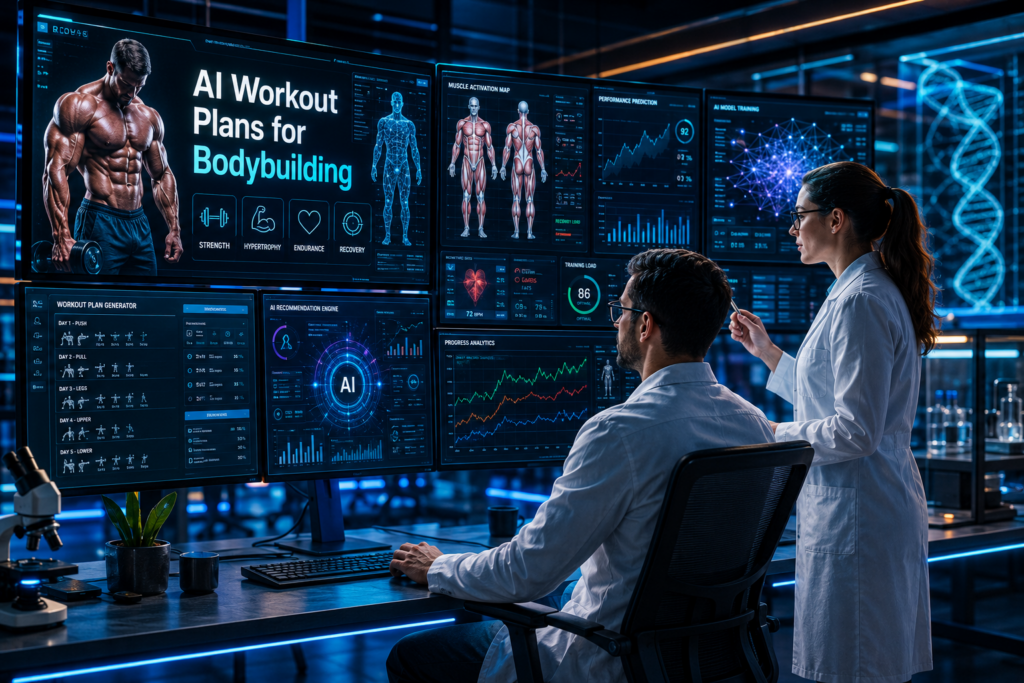
AI Workout Plans for Bodybuilding have changed the game completely. A human trainer costs hundreds of dollars each month. An app costs ten dollars. The app sees your training every single day, not twice weekly.
How AI Workout Plans for Bodybuilding Actually Work Behind the Scenes
AI builds programs from libraries containing over 4,000 exercises. Each movement connects to muscle groups it targets. The system asks your goal. It asks what equipment you own. Then it asks how many days you can train.
The system considers exercise selection, weekly volume distribution, progressive overload, and muscle-group balance. This happens in seconds. You don’t pick exercises from a list. The algorithm chooses them based on what your body needs.
If you log that a weight was easy, it pushes the load next time, and if a session crushed you, it backs off. The math happens automatically. You lift. You log. The plan adjusts.
Recovery Intelligence Separates AI Workout Plans for Bodybuilding from Static Programs
The app tracks muscle group fatigue across your full training history and uses that data to prioritize recovered muscles. This stops you from hammering quads three days straight. Fresh muscles get worked. Sore ones rest.
If your wearable tracker shows poor recovery like low heart rate variability, the AI dynamically adjusts your workout, dialing back volume or suggesting active recovery. Sleep badly on Tuesday night? Wednesday’s workout lightens automatically.
If you train a muscle again too soon when it’s still fatigued, you risk blunted gains and injury. Most people wreck their progress this way. They think more always equals better. It doesn’t.
The algorithm prevents that mistake before you make it.
What AI Workout Plans for Bodybuilding Cost Versus Human Coaching
Human personal training typically costs $50 to $150 per session, which equals $480 to $1,800 per month. That assumes two to three weekly sessions. Most bodybuilders train five to six days weekly.
AI personal trainers offering daily customized workouts cost $120 to $360 per year, creating a cost difference of 20 to 50 times. You save thousands. The programming quality doesn’t drop. It often improves.
AI fitness trainers represent just 5 to 10 percent of traditional personal training costs. That removes the biggest barrier for most people. Coaching was expensive. Now it’s accessible.
Premium AI app subscriptions cost roughly $6 to $7 per month. Free tiers exist. You can start building muscle without spending anything.
Where AI Workout Plans for Bodybuilding Fall Short
AI can’t watch you move in real time, and if your technique is wrong, logged data won’t catch it. Deadlifts with a rounded back look fine in a workout log. They destroy your spine in reality.
If you’re rehabbing an injury or learning to lift for the first time, a human coach brings hands-on form correction and physical assessment. AI can’t put its hands on your shoulders. It can’t adjust your grip mid-set.
For powerlifting meets, bodybuilding shows, and CrossFit competitions, the last 10 percent of performance benefits from human coaching experience. Elite athletes still hire coaches. They should.
Beginners learning compound movements need human eyes. Advanced competitors need specialized expertise. Everyone in between does fine with AI.
Progressive Overload Through Machine Learning
The AI adapts based on performance, bumping up weight if you hit sets easily and adjusting downward if you struggle. This matches what elite coaches do manually. The app does it every session.
For hypertrophy, AI apps prioritize volume measured as sets times reps, moderate loads at 60 to 80 percent of one-rep max. Volume drives muscle growth. The system tracks it across every muscle group.
Progressive overload plus recovery awareness drive long-term muscle and strength gains, and top apps automate both. You don’t calculate anything. The algorithm handles volume, intensity, and frequency simultaneously.
Fitbod is built on over 150 million logged workouts and leverages training history, fitness goals, and muscle recovery status. That data teaches the system what works. Your workouts benefit from millions of other lifters.
Equipment Flexibility in AI Workout Plans for Bodybuilding
AI adjusts workouts based on available equipment whether you’re training at home, in a commercial gym, or on the road. Tell it you only have dumbbells. It redesigns everything instantly.
Traveling for work this week? Input hotel gym equipment. The plan changes. Muscle groups stay prioritized. Exercise selection shifts.
This beats cookie-cutter programs entirely. Those give you barbell exercises when you own resistance bands. You either skip workouts or improvise badly.
AI removes that friction. Every session matches your actual situation.
Decision Fatigue and AI Workout Plans for Bodybuilding
Many athletes struggle because they make hundreds of training decisions every week—exercise selection, rep ranges, rest periods, volume distribution, and intensity levels—and AI reduces decision fatigue by automating these choices, which leads to greater adherence, mental energy conservation, and better results through consistent execution.
What exercises today? How many sets? What weight? How long between sets? Most people waste mental energy answering these questions. That energy should go into the actual lifting.
FitnessAI tells you exactly what to do, tracks rest periods, eliminates decision fatigue, and wastes no time. You walk into the gym. You open the app. You execute.
This matters more than people realize. Bodybuilding requires months of consistent training. Consistency breaks when every session requires planning. Remove the planning. Keep the consistency.
Frequently Asked Questions
Can AI workout plans build muscle as effectively as human trainers?
For most fitness enthusiasts, AI coaching delivers 80 to 90 percent of human coaching value at 5 to 10 percent of the cost. Muscle growth depends on progressive overload and recovery. AI automates both factors reliably.
Do AI bodybuilding apps work for complete beginners?
AI coaching works well for beginners in cardio and general fitness, but learning complex barbell movements like squats benefits from a human coach who corrects form. Start with a few in-person sessions. Then switch to AI programming.
Which AI app is best for hypertrophy training?
Alpha Progression’s RIR-based programming and specialized muscle building algorithms appeal to serious bodybuilders focused on hypertrophy. Fitbod also ranks highly for muscle building. Both apps adjust volume and intensity automatically.
How do AI trainers track muscle recovery?
Proprietary algorithms track muscle fatigue while prioritizing fresh muscle groups and preventing overtraining. The system logs which muscles you worked and when. It schedules future sessions around recovery time.
Are free AI workout apps worth using?
ChatGPT creates good enough fitness plans for most goals and available equipment but lacks automatic progress tracking. Dedicated apps like Hevy and Planfit offer free tiers with genuine AI features. They work better than generic chatbots.
Download an AI bodybuilding app today and log your first workout to see how it adapts your next session.