
Partial Reps Built Muscle Faster Than I Expected
Lengthened partial reps focus on the stretched portion of an exercise’s range of motion, helping you push past failure and intensify muscle activation. This advanced technique is gaining popularity in gyms worldwide for potentially accelerating muscle growth and strength development.
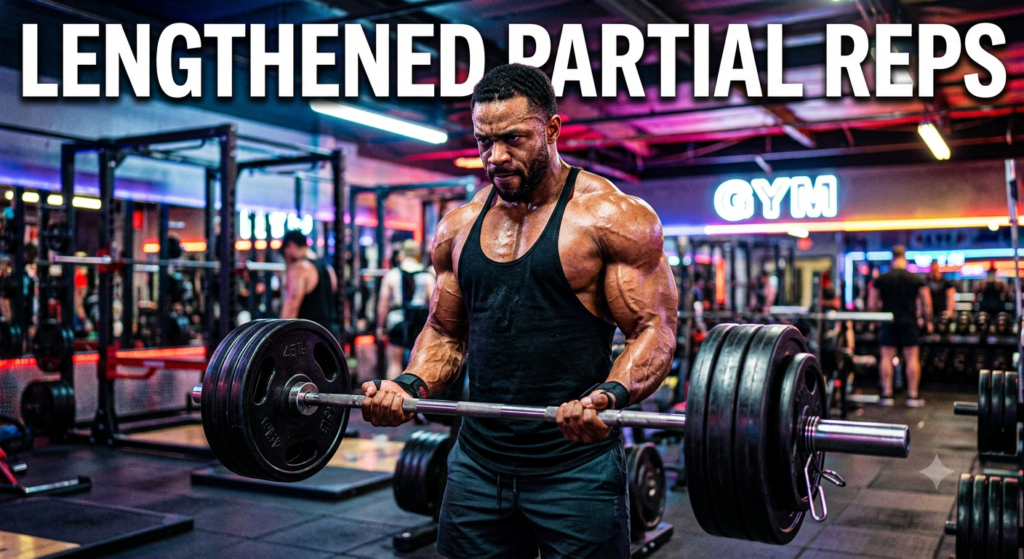
Are Lengthened Partial Reps Right for You? You reach failure on your curls. Then you keep going. Your biceps burn but the weight keeps moving. This is the lengthened partial approach gaining traction in gyms worldwide.
What Lengthened Partial Reps Actually Are
Lengthened partials are a training technique where you intentionally shorten an exercise’s range of motion, performing only the portion of each rep where your muscles are most stretched. Picture a bicep curl. You normally lift from thigh to shoulder. With lengthened partials, you only move from bottom to halfway up.
The focus is on the part of the range of motion where the muscle is stretched, such as from the bottom to the middle of a leg press or bicep curl. You skip the top portion entirely. No peak contraction. No lockout. Just work in the stretched position.
This feels backward to most people. Full range has been the gold standard for decades. But research is challenging that assumption.
Are Lengthened Partial Reps Right for You Based on Current Research?
Lengthened partials were potentially better for muscle growth compared to a full ROM with 6.76% more muscle growth. That’s from a 2024 meta-analysis. Sounds promising. But the confidence interval was huge.
A 2025 study showed that lengthened partials and full ROM resistance training stimulated similar increases in muscle thickness of the elbow flexors and extensors over 8 weeks. The differences were minimal. Some studies show a small advantage. Others show none at all.
Both training styles led to small improvements in hypertrophy and strength after 12 weeks of low volume training, with no meaningful advantage for either approach. This came from research with 297 trained participants. Real people in real gyms.
The truth sits somewhere in the middle. Lengthened partials aren’t magic. They aren’t worthless either.
When Are Lengthened Partial Reps Right for You?
You can use them to push beyond muscle failure relatively safely because muscles are stronger eccentrically and can continue to produce some force even if you’re too exhausted to do the entire concentric portion of a lift. This is the practical edge. You hit failure on full reps. Your muscles can still handle more work in the stretched position.
Most people fail their biceps curls right after passing the middle of the range of motion, and if you stop before reaching the sticking point, you can handle more weight or get more repetitions. Same applies to lat pulldowns and rows. The stretched position has more gas left in the tank.
When implementing lengthened partials, they are harder for some exercises and easier for others. On bicep curls, they let you squeeze out extra reps. On squats, they make breathing difficult and limit quality reps.
Squats and deadlifts are already hardest when your muscles are longest, and lengthened partials would be redundant. Don’t force the technique where it doesn’t fit.
Exercises Where Lengthened Partial Reps Are Right for You
Lat pulldowns aren’t usually that challenging at the bottom, meaning you could use heavier weights and only do the bottom half. You can also keep doing partial reps after failing at the top. This extends your set without compromising form.
Lateral raises, bicep curls, and calf raises are shortened biased exercises that offer greater returns when using lengthened partials. Cable lateral raises work especially well. The constant tension loads the stretched position perfectly.
Leg extensions have a decent resistance curve all through the range of motion, but you can get even more out of them by focusing on the bottom half. This is where the quads stretch under load. The top half adds less value.
Dips and lying dumbbell curls respond well too. The stretched position feels brutal on these movements. That burn signals real work happening.
If You Are going to use Lengthened Partial Reps Then You Definitely
Needs These!
How to Know if Lengthened Partial Reps Are Right for You
Lengthened partials likely increase strength through the ROM you train, but probably won’t make you stronger through a full ROM—a concept called specificity of training. Your sport or daily life might need full range strength and functional mobility. If you’re an athlete training for athletic performance, a sport-specific movement pattern, or activities requiring complete range engagement, this limitation matters significantly. You may develop strength in the stretched position without building strength in the shortened, contracted position where power is often generated.
It’s difficult to standardize ROM on lengthened partials, which makes tracking performance over time challenging and adds a layer of complexity that most prefer to avoid. Where exactly do you stop each rep? Bottom to parallel? Bottom to 45 degrees? Inconsistency creeps in fast.
Lengthened partials tend to be more uncomfortable because the muscles are kept in a stretched position, and trainees must also be more mindful of their range of motion each rep and keep it consistent. This demands focus. Every single rep.
Lengthened partials involve performing your reps in the most stretched part of the range of motion only, so they can lead to better, faster mobility gains than full range of motion training. If you lack mobility somewhere, this technique might help. But that’s still theoretical.
Practical Ways to Test if Are Lengthened Partial Reps Right for You
The easiest way to capitalize on this form of training would be to turn the last set of each of your exercises into a lengthened partial set, performing the first 2 sets with a full range of motion, and then performing the final set in a lengthened partial manner. This gives you the best of both worlds.
Lengthened partials involves doing some partial reps in the stretched position after reaching full ROM failure. You don’t replace everything. You add them at the end when you’re cooked. Three extra partial reps after hitting failure adds volume without adding sets.
Start with one or two exercises per workout. Pick movements where the stretched position is hardest. Track what happens over four weeks.
Compare how you feel. Does your target muscle feel more worked? Can you recover between sessions? These signals matter more than following trends.
The Downsides That Determine if Lengthened Partial Reps Are Right for You
Despite growing interest in lengthened partials, current evidence does not support the notion that they are significantly superior to full range of motion training. The hype outpaces the data. Social media makes them sound revolutionary. Science says they’re comparable at best.
Trainees seeking to maximize muscle size should likely emphasize the stretched position, either by using a full ROM or lengthened partials during upper-body resistance training. Notice that. Either option works. The emphasis on the stretch matters more than the specific technique.
You can achieve similar results by choosing exercises that naturally load the stretched position. Deep dumbbell flyes. Deficit Romanian deadlifts. Overhead tricep extensions. These hit the stretch through full range.
That’s simpler than counting partial inches on every rep. Less mental load means better consistency long-term.
Making Your Decision About Lengthened Partial Reps
Are Lengthened Partial Reps Right for You depends on your training age. Beginners gain muscle from almost anything. The technique won’t make or break your progress. Focus on basic compound movements first.
Intermediate lifters can experiment strategically. Use them as a finisher on stubborn muscles. Add them after regular sets to extend time under tension.
Advanced lifters might see small benefits worth the extra effort. When progress slows to a crawl, tiny edges matter. That potential 5% boost becomes relevant.
Your tolerance for complexity factors in too. Some people love tweaking variables. Others just want to lift heavy and go home. Both approaches build muscle.
Recovery capacity plays a role. Lengthened partials add volume without adding sets. If you’re already struggling to recover, this technique could backfire.
Frequently Asked Questions
What are lengthened partial reps?
They’re half reps performed only in the stretched position of an exercise. You skip the top portion where the muscle fully contracts. This keeps tension on the muscle at its longest length throughout the set.
Do lengthened partials build more muscle than full range?
Current research shows they’re roughly equal to full range of motion training. Some studies show a small advantage for lengthened partials. Others show no meaningful difference between the two approaches.
Which exercises work best for lengthened partial reps?
Bicep curls, lat pulldowns, rows, lateral raises, and calf raises respond well. These exercises naturally become easier at the top. Lengthened partials let you keep working when full reps become impossible.
Are lengthened partial reps safe to perform?
Yes, when done with control and proper form. They actually force you to use less weight than top-half partials. The stretched position is mechanically disadvantaged, which limits how much you can lift.
How often should I use lengthened partial reps?
Start by adding them to your last set on one or two exercises. You can also do a few partial reps after reaching failure on regular sets. Don’t replace all your full range work immediately.
Try lengthened partials on your next arm workout and compare how your muscles feel the next day.