

High Frequency Training Might Waste Your Recovery Time
Recent research analyzing 25 volume-equated trials shows high frequency and low frequency training produce similar muscle hypertrophy results when total weekly volume is matched. The key factor for muscle growth is total training volume, not how many times per week you train each muscle group.
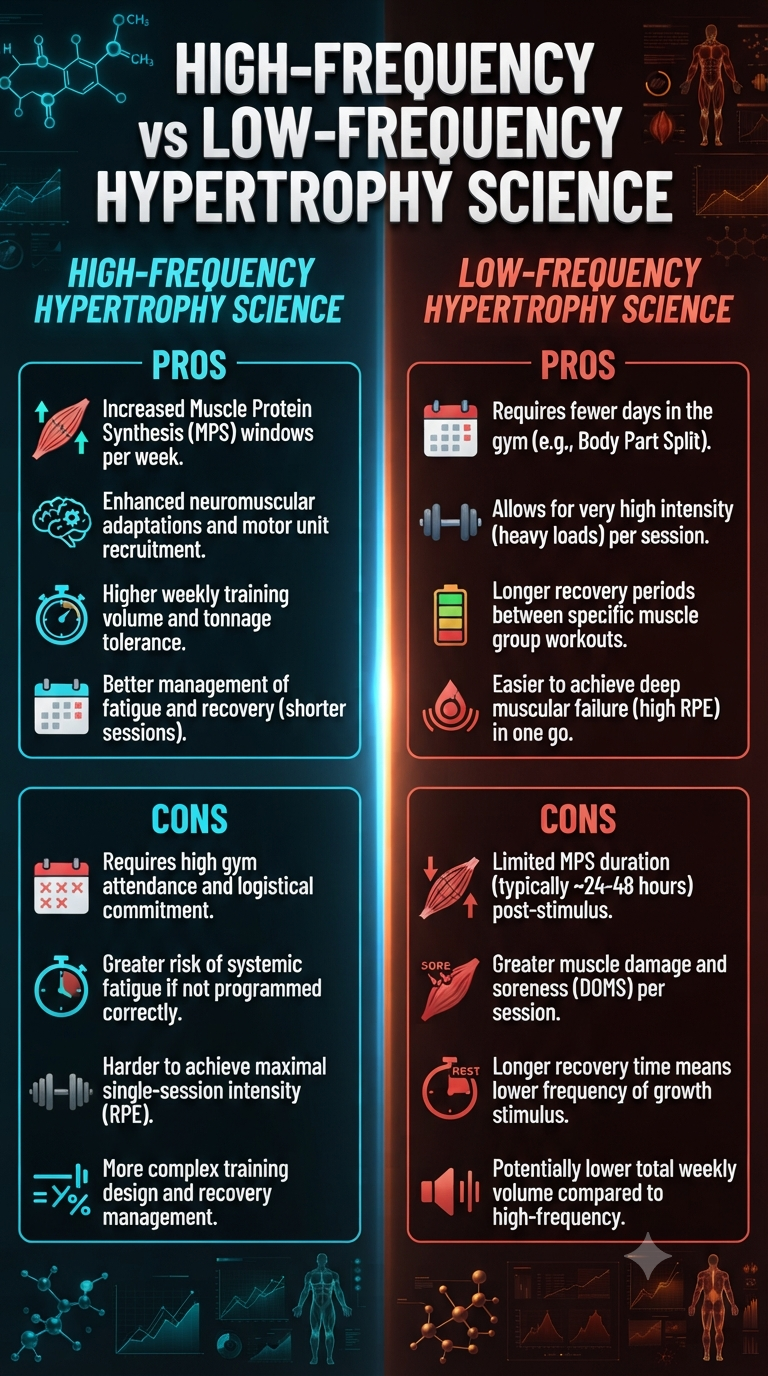
You walk into gyms worldwide and see two camps. One trains chest once weekly with brutal volume. The other hits it three times with moderate sets. High Frequency vs Low Frequency Hypertrophy Science shows no significant difference when volume is matched.
What High Frequency vs Low Frequency Hypertrophy Science Actually Measures
Frequency means how many times you train a muscle each week. Low frequency typically means once per week. High frequency means two to three times weekly. Researchers pooled 25 volume-equated trials. They compared once weekly training to multiple weekly sessions.
Volume refers to total sets per week. If you do twelve chest sets Monday, that’s identical volume to six sets Monday plus six Thursday. Studies found no statistically significant differences in muscle hypertrophy outcomes between low and high frequency. The key word is volume-equated.
Training volume drives hypertrophic adaptations rather than frequency alone. This contradicts what most gym conversations suggest. People assume more frequent training automatically builds more muscle. Wrong.
Muscle Protein Synthesis in High Frequency vs Low Frequency Hypertrophy Science
Protein synthesis stays elevated about 48 hours after training. Quads stayed in protein synthesis for up to 48 hours after training. This fact drives the frequency argument. If synthesis drops after two days, why wait seven days to train again?
Sound familiar? The logic seems airtight. But here’s the catch. You can have soreness in a muscle without it being in protein synthesis. Muscle damage and growth signals are separate processes.
Meta-analytic data show little difference in hypertrophy with frequencies ranging from 1 to 6 days per week. That’s a massive range. Weekly volume still determines results. Protein synthesis windows matter less than total mechanical tension accumulated across seven days.
Real Strength Differences in High Frequency vs Low Frequency Hypertrophy Science
Distributing weekly training over four sessions resulted in greater strength increases compared to one weekly session. Both strategies resulted in similar hypertrophy. Strength and size respond differently to frequency.
Three training sessions per week showed 65% strength gains versus 43% for one session weekly. This is not marginal. Frequency helps strength, with training twice weekly producing modest strength gains over once.
Why does this matter? Strength improvements let you lift heavier loads over time. Heavier loads create more tension. More tension eventually means more growth. The frequency benefit shows up indirectly through better strength progression.
Individual Response Variance in High Frequency vs Low Frequency Hypertrophy Science
People respond differently to frequency changes due to factors like training age, recovery capacity, genetic predisposition, and nervous system adaptability. Some individuals showed greater muscle gains after high frequency training while others had greater gains with low frequency. Both groups existed in the same study, demonstrating responder variability and non-responder patterns that contradict one-size-fits-all programming approaches.
Individual manipulation of training frequency can improve responsiveness to training. This means testing matters. Running a low frequency phase then a high frequency phase reveals your personal response. Individual variability in response to frequency manipulation highlights potential for personalized programming.
Track your results over eight weeks. Switch frequency while keeping volume constant. Measure arm circumference or thigh thickness. The scale lies but a tape measure doesn’t.
Session Fatigue Changes High Frequency vs Low Frequency Hypertrophy Science Outcomes
Perceived exertion was significantly higher in one session weekly than three sessions weekly. One group reported exertion levels of 7.3 to 8.3. The other reported 4.3 to 5.3. That’s a brutal difference.
When session volume gets very high, evidence favors splitting volume into more frequent sessions. Fifteen plus sets in one workout crushes performance quality. Your tenth set of squats looks nothing like your second set.
Form breaks down. Joints ache. Mental focus disappears. Splitting volume across sessions means each workout is less fatiguing. You maintain higher effort and better form on every set. Better sets mean better growth stimulus despite identical volume.
When to Choose Lower Frequency Based on High Frequency vs Low Frequency Hypertrophy Science
Low frequency works when you can’t train muscle groups multiple times weekly. When weekly volume is matched, there is little difference in muscle size gains. Three total workouts weekly still builds muscle effectively.
There’s little evidence that doubling training frequency to six times weekly leads to greater gains. More isn’t always better. Recovery capacity limits frequency benefits eventually.
Older lifters often need lower frequencies. Individuals over 40 often require 72 hours or more between sessions. Hormonal changes slow recovery. Joint stress accumulates faster. Two weekly sessions per muscle beats three for many older adults.
When to Use Higher Frequency According to High Frequency vs Low Frequency Hypertrophy Science
Choose higher frequency when you want strength gains alongside hypertrophy. High resistance training frequency seems to favor lower limb muscle strength in trained adults. The skill practice component of lifting matters for strength development.
Two training sessions per week increased hypertrophy by 6.8% versus 3.7% for once weekly. That’s 48% more growth in studies without matched volume. Higher frequency makes it easier to accumulate sufficient volume.
Spreading sets prevents junk volume. Your muscles work better when fresh. Higher frequency coupled with more volume leads to greater muscle growth. Frequency becomes a tool to enable higher weekly volume without destroying recovery.
Practical Application of High Frequency vs Low Frequency Hypertrophy Science
Start by counting your current weekly sets per muscle. Chest gets twelve sets? Keep twelve sets. Redistribute them across two or three sessions instead of one.
If performing 15 chest sets Monday, split them into sets Monday and sets Thursday. Same volume, different distribution. Monitor recovery carefully during the first few weeks as muscles adapt to different stimulus patterns.
Don’t add frequency and volume simultaneously. That’s how people overtrain. Change one variable at a time. Test for six to eight weeks. Measure results objectively. Adjust based on data, not feelings.
Frequently Asked Questions
Does training a muscle once per week build muscle?
You can make similar strength and hypertrophy gains working out only one day per week. Low frequency still works. Higher frequency may produce slightly better results when volume is equal.
How long does muscle protein synthesis stay elevated after training?
Muscle protein synthesis stays elevated for approximately 24 to 48 hours after training. Protein synthesis remained elevated above rest at 24 hours in specific training conditions.
What training frequency is best for beginners?
Train each muscle group at least twice per week for optimal growth. Spreading weekly volume across two to three sessions keeps protein synthesis elevated longer.
Should advanced lifters train with high or low frequency?
Advanced lifters often manipulate frequency on a muscle-by-muscle basis. They train lagging body parts more often while maintaining stronger ones with less frequent sessions.
How many sets per muscle group should I do weekly?
Five to 10 sets optimized muscle gains. Evidence suggests 10 plus sets per muscle group weekly provides sufficient stimulus for hypertrophy.
Test both frequencies with matched volume for eight weeks and measure which produces better strength gains.


