
Why Skinny-Fat Lifters Waste Years on Wrong Body Recomposition
Body recomposition allows you to build muscle and lose fat at the same time, making it the ideal approach for skinny-fat beginners who don’t have enough muscle mass to cut effectively. Your untrained body responds rapidly to resistance training, enabling dramatic changes in body composition even when the scale barely moves.
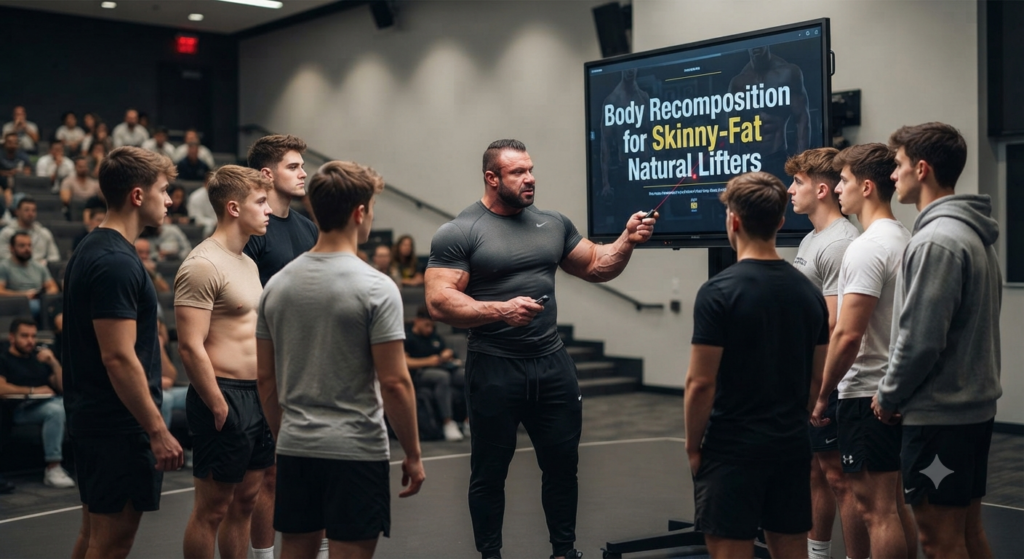
You look soft despite eating less than your friends. The scale shows normal weight. Your reflection tells a different story. Body Recomposition for Skinny-Fat Natural Lifters means building muscle while losing fat at the same time.
What Body Recomposition for Skinny-Fat Natural Lifters Really Means
Most people think you either bulk or cut. That approach fails for skinny-fat beginners. You don’t have enough muscle to cut down to. Cutting first leaves you looking smaller and weaker.
Body recomposition changes both tissues at once. You gain muscle tissue every week. You also lose fat tissue every week. The scale might not move much. Your body shape changes dramatically.
This works because you’re untrained. Your body responds to resistance training fast. Newbie gains let you build muscle even in a small calorie deficit. Advanced lifters can’t do this anymore.
The typical skinny-fat person carries 20 to 28 percent body fat. They have very little lean mass. Their arms measure under 13 inches flexed. Their legs look thin in jeans.
Starting with recomposition fixes both problems together. You see progress in the mirror within six weeks. Your clothes fit better. Your lifts go up every session.
Training Principles for Body Recomposition for Skinny-Fat Natural Lifters
You need to lift weights four days per week. Three days minimum. Two days won’t create enough stimulus. Your muscles need frequent tension to grow.
Focus on compound movements first. Squats build your legs and core. Deadlifts work your entire back side. Bench press grows your chest and triceps. Overhead press develops your shoulders.
Train each muscle group twice per week. Monday and Thursday for upper body works well. Tuesday and Friday for lower body. This frequency beats training each part once weekly.
Progressive overload matters more than anything else. Add weight to the bar every week. Even 2.5 pounds counts as progress. Write down every set and rep.
Keep rep ranges between 6 and 12 per set. Going lower builds strength without much size. Going higher doesn’t create enough tension. The 8 to 10 range works best for most exercises.
Rest 90 seconds between sets for upper body. Rest two to three minutes for heavy squats and deadlifts. Your heart rate should drop before the next set. Rushing between sets kills performance.
Cardio stays minimal during this phase. Two 20-minute walks per week is enough. Too much cardio interferes with recovery. Your body can’t build muscle while running five miles daily.
Nutrition Strategy for Body Recomposition for Skinny-Fat Natural Lifters
Eat at maintenance calories to start. Track your weight for two weeks. If it stays the same, you found your maintenance. That’s your baseline number.
Drop 200 calories below that baseline. This small deficit lets you lose fat slowly. You still have enough energy to build muscle. Bigger deficits stop muscle growth completely.
Protein intake needs to hit 0.8 grams per pound of body weight. A 160-pound person eats 128 grams daily. Spread this across four meals. Each meal should contain 30 to 35 grams.
Chicken breast provides 31 grams per four ounces. Greek yogurt gives you 17 grams per cup. Eggs deliver six grams each. Ground beef at 90 percent lean offers 24 grams per four ounces.
Carbs fuel your training sessions. Eat most carbs around your workouts. A meal with 40 grams of carbs two hours before lifting works perfectly. Another 50 grams right after training helps recovery.
Fat fills the remaining calories. Don’t go below 50 grams per day. Your hormones need dietary fat to function. Testosterone production drops when fat intake gets too low.
Meal timing isn’t magic but it helps. Eating protein every four hours keeps muscle protein synthesis elevated. Skipping meals for eight hours wastes opportunities for growth.
How Body Recomposition for Skinny-Fat Natural Lifters Differs from Bulking
Traditional bulking adds 500 calories above maintenance. You gain a pound per week. Half of that weight comes from fat. Skinny-fat people already carry too much fat.
Bulking makes you look worse before you look better. Your face gets rounder. Your waist expands by two inches. You hide under baggy shirts for six months.
Body Recomposition for Skinny-Fat Natural Lifters keeps you looking decent throughout. Your abs start showing as you gain muscle. People notice positive changes within two months. Nobody asks if you’ve been eating too much.
The scale moves differently too. Bulking shows clear upward trends weekly. Recomposition shows the scale staying flat for weeks. Some people even drop five pounds while gaining visible muscle.
Strength gains happen faster when bulking. You might add 20 pounds to your bench in eight weeks. Recomposition produces slower strength gains. Expect 10 pounds on your bench over eight weeks instead.
The payoff comes later. After six months of recomposition, you look athletic. After six months of bulking, you need to cut. That cut takes another three months minimum.
Common Mistakes That Stall Progress
Changing your program every three weeks ruins everything. Your body needs time to adapt. Stick with the same exercises for 12 weeks minimum. Only change when progress completely stops.
Skipping legs keeps you looking skinny-fat. Your legs contain the most muscle mass. Building them releases more growth hormone. Upper body growth actually speeds up when you train legs hard.
Eating too little sabotages the entire process. A 500-calorie deficit might seem faster. Your body enters starvation mode instead. Muscle growth stops completely at that deficit level.
Drinking alcohol three times per week kills recovery and undermines body recomposition progress. One night of drinking disrupts muscle protein synthesis for 24 hours, reducing myofibrillar protein development and impairing testosterone levels. Alcohol also impairs nutrient absorption and increases cortisol, a catabolic hormone that works against hypertrophy. Two drinks maximum if you must drink. Three nights per week means you’re recovering only four days weekly, limiting the frequency needed for consistent strength gains and muscular adaptation.
Sleeping five to six hours nightly prevents muscle growth. Growth hormone releases during deep sleep. You need seven to eight hours minimum. An extra hour of sleep beats an extra workout.
Measuring progress by scale weight alone causes panic. You might gain two pounds of muscle and lose two pounds of fat. The scale shows zero change. Photos and measurements tell the real story.
Timeline and Expectations
The first month shows small changes. Your lifts increase every session. Your shoulders look slightly wider in shirts. Body fat drops by one percent.
Month two brings visible differences. Friends start commenting on your appearance. Your arms measure half an inch larger. Your waist shrinks by one inch.
By month three, the transformation becomes obvious. You’ve built five to seven pounds of muscle. You’ve lost six to nine pounds of fat. Your body fat percentage dropped three to four points.
Month six marks the end of easy recomposition. You’ve gained 10 to 12 pounds of muscle total. Your body fat sits around 12 to 15 percent. Further progress requires choosing either gaining or losing.
Realistic muscle gain for natural lifters tops out around two pounds monthly. First-year lifters hit this rate easily. Second-year lifters gain one pound monthly. Third-year lifters see half a pound monthly.
Fat loss happens at half a pound weekly with proper setup. Some weeks show one pound lost. Other weeks show nothing. The monthly average matters most.
When to Switch Strategies
Stop recomposition when your lifts plateau for four straight weeks. This signals you need more calories. A small surplus helps you break through strength barriers.
Switch to cutting if you’re still above 18 percent body fat. Get down to 12 percent first. Then start a gaining phase. Building muscle shows better at lower body fat levels.
Your training age determines strategy too. After one full year of proper training, recomposition slows down. You’ll make better progress with dedicated bulking and cutting phases. Each phase should last three to four months minimum.
Listen to your energy levels throughout the day. Constant fatigue means you’re undereating. Add 100 calories and reassess weekly. Feeling strong and recovering well means you’re on track.
Frequently Asked Questions
How long does body recomposition take for skinny-fat beginners?
Most people see clear visual changes within three months. Complete transformation takes six to nine months. Your starting body fat percentage affects the timeline significantly.
Can you build muscle and lose fat simultaneously as a natural lifter?
Yes, but only if you’re untrained or returning after a long break. Advanced lifters must choose one goal at a time. The effect works best in your first year of training.
What body fat percentage should you reach before bulking?
Men should get to 12 percent or lower first. Women should reach 20 percent or lower. Starting a bulk at higher percentages makes you look worse quickly.
How much protein do you really need for body recomposition?
Aim for 0.8 grams per pound of body weight daily. Going higher doesn’t increase muscle growth. Going lower slows your progress down noticeably.
Should you do cardio during body recomposition?
Light cardio like walking helps recovery and burns extra calories. Heavy cardio like running interferes with muscle growth. Keep cardio sessions under 30 minutes twice weekly.
Start tracking your food and lifting weights four times this week.