

Everything You've Been Wrong About Creatine
Forget the gym myths about creatine timing and loading phases—what actually matters is taking it daily to maintain muscle saturation. We bust the biggest creatine misconceptions, including the hair loss myth, so you can optimize your supplementation strategy with science-backed facts.
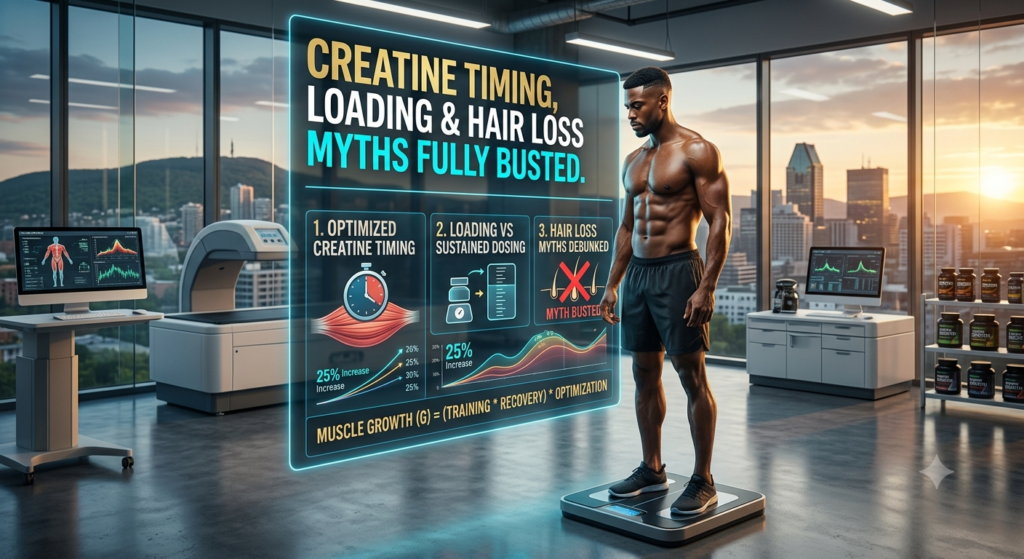
You walk into a gym and someone swears creatine only works pre-workout. Another says loading is a must. A third guy stopped using it because he’s losing hair. Creatine Timing, Loading & Hair Loss Myths Fully Busted starts with one truth: the best dose is the one you take daily.
Creatine Timing, Loading & Hair Loss Myths: When You Take It Doesn’t Matter
The internet overflows with timing debates. Should you take creatine before training? After? Morning or night? Studies have found that it is less important when you take it, and matters most that you take it every day to keep saturation. Your muscles don’t empty creatine stores mid-workout. They stay filled when you dose consistently.
Many gym-goers assume creatine functions like a pre-workout stimulant, providing an immediate energy boost when taken before training. This misconception leads to overthinking supplement timing rather than focusing on the factor that actually drives results: consistent daily intake. Creatine isn’t caffeine. It works by building up phosphocreatine levels over weeks, not minutes.
Several studies suggest taking creatine after your workout may lead to slightly better muscle and strength gains compared to pre-workout. A notable 2013 study published in the Journal of the International Society of Sports Nutrition found that post-workout creatine supplementation produced greater increases in lean muscle mass and strength over 4 weeks compared to pre-workout timing. However, a 2021 analysis found that differences between pre- and post-workout supplementation became statistically insignificant when viewed across longer timeframes and larger sample sizes. The research found that total daily creatine intake mattered far more than the specific timing of doses.
Here’s what matters. Pick a time you’ll remember. Post-workout with protein works. Morning with breakfast works. Evening with dinner works. Skipping days kills progress faster than poor timing ever will.
The Loading Phase Myth in Creatine Timing, Loading & Hair Loss
The loading phase bridges that gap quickly, moving you to 100% saturation in just a few days. A typical phase lasts between 5 and 7 days to ensure full muscle saturation. The protocol involves daily creatine dosage during this time typically ranges from 20 grams to 25 grams. You split this into four or five doses throughout the day.
Worth doing? Not really. A creatine loading phase is not necessary to reap the many fitness and health benefits of creatine, but the loading phase will saturate your muscle stores of creatine much faster compared to not completing a loading phase. The key word is faster, not better.
In a pivotal “loading vs. maintenance dose” study, muscle creatine accumulation was virtually the same (~ 20% increase) after participants consumed just 3 grams per day for 28 days or a much-larger 20 grams per day for six days. You reach the same destination either way. Loading gets you there in a week. Daily maintenance doses get you there in four weeks.
Research shows that within one month, lower doses of 3-5 grams per day build up equally well in your muscles. Most people skip loading entirely. Studies indicate it can take approximately 3-4 weeks (around 28 days) to reach similar muscle creatine levels as a loading phase. Four weeks passes fast. The stomach issues from 20 daily grams last longer than the time you save.
Those who are very prone to bloating or digestive issues may want to skip the loading phase and start with the maintenance dose. In some people, creatine can cause bloating due to water retention, cramping, or diarrhea when taken in very high doses. This alone makes loading questionable for most users.
Creatine and Hair Loss: The Biggest Myth in Creatine Timing, Loading & Hair Loss Debates
One 2009 study scares everyone, despite serious methodological limitations. In 2009, researchers in South Africa recruited just 20 college rugby athletes to participate in a 3-week study examining the impact of creatine monohydrate supplementation on androgens and androgenic hormones. The athletes were randomized into two groups: those who received creatine supplementation for 3 weeks and those who received a placebo control. Their serum testosterone levels and dihydrotestosterone (DHT, the more potent androgen metabolite responsible for androgenic effects like male pattern baldness) were measured at baseline and after the 3-week intervention period using standard hormone assay methods.
The athletes in the creatine supplement group had higher DHT levels and a higher testosterone-to-DHT ratio at the end of 3 weeks. The researchers theorized that changes in androgen hormones may be one mechanism underlying creatine’s effects. But here’s the problem. The study measured hormone levels. It did not measure hair shedding, hair density, follicle miniaturization, or hair loss progression. No participants were reported to have developed hair loss during the study.
This study stands alone. The small 2009 study showing an increase in DHT is currently an outlier amongst the totality of evidence. No other research has repeated these findings. No study has been able to recreate those results. Twelve additional studies have looked at the effects of creatine on testosterone. None have reported significant hormonal increases.
The major finding of the current study was that, in a randomized double-blind placebo-controlled trial, there was no effect of 12 weeks of supplementation compared to placebo on changes in DHT or testosterone. This 2024 study directly tested the hair loss question. There were no significant differences in DHT levels, DHT-to-testosterone ratio, or hair growth parameters between the creatine and placebo groups. This study was the first to directly assess hair follicle health following creatine supplementation, providing strong evidence against the claim that creatine contributes to hair loss.
There’s no evidence showing that creatine is linked to hair loss or alopecia. No other studies have found that people taking creatine supplements have a higher rate of hair loss. Most have found that people taking creatine supplements don’t have elevated levels of either of these hormones. The myth persists because one small study got massive attention. The dozen studies showing no effect got ignored.
The Only Dosage That Works in Creatine Timing, Loading & Hair Loss
Standard dose: 3–5 grams of creatine monohydrate per day is the evidence-backed maintenance dose for most people. Not 2 grams. Not 10 grams. Studies show that 5 grams of creatine daily is safe and effective. It helps with athletic performance and muscle recovery.
Five grams hits the sweet spot. While the standard dosage recommendation is 3-5 grams, 5 grams is the most-studied dosage and is linked with the benefits most people seek. You can measure 5 grams easily. Most scoops in creatine tubs hold exactly this amount.
Creatine is not a stimulant; it works by maintaining steady levels in the muscle and the brain. Skipping days can cause dips in stores. For best results, take daily, just like a multivitamin. Missing two days per week means you never reach full saturation. Your progress stalls before it starts.
Some people think body weight changes the dose. Body weight can influence your optimal creatine dose, since larger individuals have more muscle mass to saturate. Some research suggests dosing at approximately 0.03 grams per kilogram of body weight per day, which can put heavier athletes closer to the higher end of the 3–5 gram range or slightly above. But most research uses 5 grams across all weights. Unless you’re a 250-pound bodybuilder, stick with 5 grams.
Most research uses creatine monohydrate, making it the gold standard. Creatine ethyl ester sounds fancy. Buffered creatine promises better absorption. Variants like creatine ethyl ester or buffered creatine haven’t shown significant added benefits in studies. Stick to monohydrate for proven results. Monohydrate costs less and works better than expensive alternatives.
What Actually Happens When You Take Creatine Daily
Research indicates that consistently taking 3 grams of creatine daily can lead to full muscle saturation in approximately 28 days, or about 3-4 weeks. Week one feels like nothing. Week two brings subtle changes in rep count. Week three shows noticeable strength gains. Week four delivers full saturation.
Saturation means your muscles store maximum phosphocreatine. Saturated muscle creatine stores mean your body has maximized its capacity for phosphocreatine, which is crucial for rapidly regenerating ATP (cellular energy). This can lead to increased muscle strength and power, improved performance during high-intensity exercise, potentially faster recovery between workouts, and support for muscle growth over time. ATP powers every muscle contraction. More phosphocreatine means faster ATP regeneration between sets.
You’ll gain weight immediately. Creatine can cause a temporary increase in body weight, typically 1-3 pounds. This isn’t fat. You might notice the scale go up by two to four pounds during the first week of supplementation. Don’t panic—this is not fat gain. It is almost entirely water being pulled into your muscles. Water inside muscle cells is good. It improves cell volume and protein synthesis.
Stop taking creatine and levels drop. If you stop supplementing entirely, your muscle creatine levels will gradually decline as your body uses the stores and they are not replaced. It usually takes about 4 to 6 weeks for your muscle stores to return to their pre-supplementation baseline. Four to six weeks of decline means four to six weeks of reduced performance. Consistency beats cycling.
Modern research suggests that cycling is unnecessary. Once your muscles are saturated, you can stay at that level indefinitely by taking a 3 to 5-gram maintenance dose daily. Old advice said cycle on and off. New research says stay on. Your body doesn’t stop producing its own creatine. There is no evidence that long-term, consistent use reduces your body’s ability to produce its own creatine.
Frequently Asked Questions
Does creatine need to be taken at a specific time to work?
No, timing doesn’t matter nearly as much as daily consistency. Taking it post-workout may offer slight advantages, but missing doses hurts more than poor timing. Pick a time you’ll remember and stick with it.
Is a loading phase necessary to see results from creatine?
Loading isn’t necessary. Taking 5 grams daily reaches full saturation in 28 days. Loading reaches it in 5-7 days but often causes stomach issues. Both methods achieve identical final results.
Will creatine cause hair loss or baldness?
No evidence supports this claim. One 2009 study showed DHT increases but measured no hair loss. Twelve newer studies found no hormonal changes. A 2024 study directly measured hair health and found zero effect.
How much creatine should I take per day?
Take 3-5 grams daily, with 5 grams being the most-studied dose. This amount works for nearly everyone regardless of body weight. Skip the loading phase and take 5 grams from day one.
How long does creatine take to fully saturate muscles?
Full saturation takes 3-4 weeks with daily 5-gram doses. You’ll notice strength improvements around week two. Full benefits appear after 28 days of consistent use.
Start taking 5 grams of creatine monohydrate daily at whatever time fits your schedule.